Terrestrial/underground applications

Eurohinca (Europea de Hincas Teledirigidas, S.A.), Trenchless specialist since 1996 - 14 TBMs and >120 km executed.

We run terrestrial and subway applications:
road, rail and river crossings with microtunneling (MTBM), HDD, Direct Pipe, vertical wellssegment tunnel - precise routing, minimal impact and ISO 9001/14001/45001 compliance.

terrestrial applications

Ground and subway engineering

At Eurohinca we are specialists in advanced solutions for terrestrial and subway applications. With more than 40 years of experience, we implement tunneling technologies that allow us to execute from urban sewage systems to gas pipelines o drainage works.
Our experience allows us to adapt to complex terrains and the most demanding conditions, guaranteeing safety and sustainability in each project.

Experience in subway and underground projects

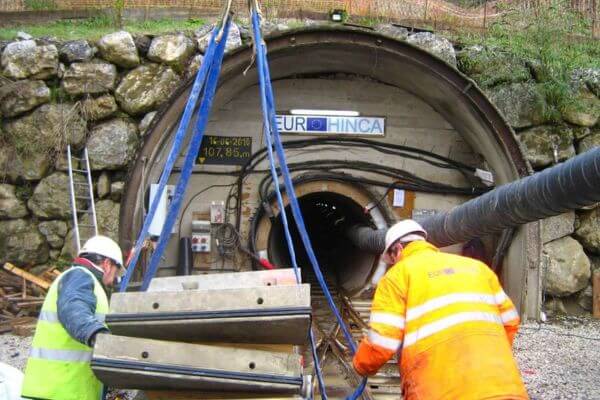
We have an international track record in the execution of tunnels using closed shield tunnel boring machines, pipe ramming y horizontal directional drilling.
We have participated in projects of urban supply systems, infrastructure crossings y seawater catchment for desalination, always with the premise of minimizing environmental impact.

The European Commission promotes the application of these techniques in its sustainable urban infrastructure guide, an international reference in complex urban projects.

terrestrial or subway applications

Types of terrestrial or subway applications

We offer solutions for a wide range of applications, including:

Service specifications for ground and subway applications

Terrestrial and subway applications of trenchless technologies cover a wide range of solutions for buried installations in urban, industrial and infrastructure areas. Their analysis and implementation are based on the following technical and planning parameters:

Scope of application: Crossings under urban roads, highways, freeways, railroads, industrial environments, congested utility areas and areas where open cut excavation is not feasible due to impact, depth or interference.

Selection of the appropriate method: The decision between microtunneling, pipe jacking, Direct Pipe®, HDD or mechanized tunneling depends on the geotechnics, water table, depth of the route, length of the crossing and environmental constraints.

Ground conditions: Cohesive, sandy, silty, mixed or rocky soils. The presence of groundwater, permeability, strength and stability directly influence the choice of shield type or drilling system.

Diameters and types of conduction: Depending on the service (sewerage, water supply, electricity, telecommunications or industrial pipelines), the solution may adopt non-visitable pipes or lined visitable tunnels.

Typical lengths of the crossings: From short sections for urban crossings to larger crossings under critical infrastructures or large industrial facilities, depending on the method and logistics of the work.

Civil works requirements: Attack and reception shafts for microtunneling, jacking and Direct Pipe®, drilling platforms for HDD, portals for mechanized tunneling and access areas compatible with the operation of specialized machinery.

Interference and existing services: Identification and protection of pipelines, cables, foundations and other nearby infrastructure. This analysis determines elevations, alignment, control methods and preventive measures.

Quality control and traceability: Monitoring of excavation parameters, guidance and face pressure in pressurized methods, alignment verification, tightness tests, geometric control, CCTV inspection and as-built records.

Security and environment: Risk assessment in confined spaces, traffic and pedestrian management in urban areas, vibration control and minimization of impacts on third parties during execution.
What they think of us

International Experience

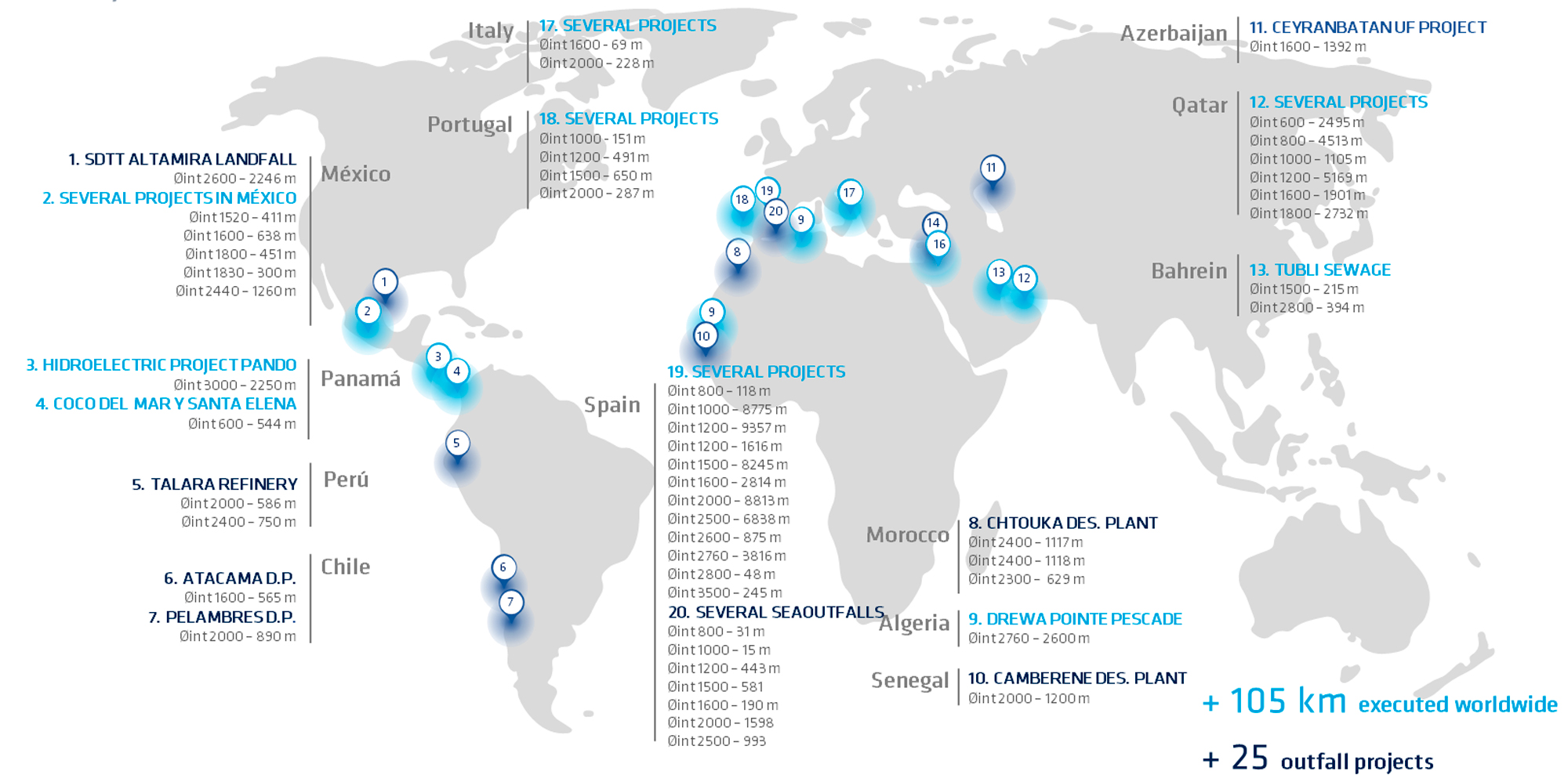
Projects around the world

We have developed projects in Europe, Latin America, Africa and Asia, applying these solutions in urban and natural environments. From submarine emissaries to sewage systems, Each work represents a technical challenge successfully overcome.
See more examples in our works executed.

Terrestrial and subway applications - rapid response

What are land and subway applications?

The terrestrial and subway applications group together actions to install subsurface infrastructures (crossings and sections in urban, industrial or service corridors), where the execution is conditioned by the environment and interferences. Depending on the case, it can be solved with trenchless solutions such as microtunnel o pipe ramming.

When to use

They are used when trenching is difficult or undesirable due to traffic, easements, existing services or environmental restrictions. Depending on the layout and constraints, it can also fit horizontal directional drilling (HDD) o Direct Pipe.

Minimum information for a first review

  • Approximate location and objective of the project (what is to be installed or solved).

  • Sketch or plan with preliminary layout and start/end points.

  • Known restrictions: access, occupancy, schedules, traffic and existing services.

  • Available land information (if any) and owner/operator requirements (if applicable).

What you get after an initial review

  • Identification of main conditioning factors.

  • Short list of missing information (if any) and recommended next steps.

If you want to move forward with a query, you can do so from Contact.

Request for information

Tell us about your overland or subway infrastructure project.

We will advise you with the best solution adapted to your needs.

News that may interest you

Keep up to date with our news on land and subway applications, where we share case studies, innovations and trends in the sector.