River and watercourse crossings

Eurohinca (Europea de Hincas Teledirigidas, S.A.), Trenchless specialist since 1996 - 14 TBMs and >120 km executed.

We run river and watercourse crossings with microtunneling (MTBM), HDD y Direct Pipe — minimal turbidity, scour control, and compliance with ISO 9001/14001/45001. See references.

river and watercourse crossings

Safe tunnels for river and watercourse crossings

At Eurohinca, we develop advanced solutions for the construction of underground tunnels beneath rivers and waterways, ensuring safety, durability, and minimal environmental impact. These construction projects are essential for gas pipelines, urban sewer system y dam spillways.

Find out more on our News about water and underground projects or check out the Frequently Asked Questions About Water Crossings to answer common questions.

Construction of subway aquatic infrastructures

Our experience in excavation with closed shield tunnel boring machines y direct pipe It allows us to carry out projects under extreme conditions while maintaining an uninterrupted water flow. These solutions are used in construction projects such as seawater catchment y crossings of marine protected areas.

The International Commission on Large Dams (ICOLD) emphasizes the importance of designing river crossings with safe infrastructure that ensures both the stability of the ground and the sustainability of water resources.

tunnels for river and watercourse crossings

Service Specifications for River Crossings and Waterways

Crossings over rivers and waterways require trenchless solutions capable of ensuring ground stability, pressure control, and minimal impact on the watercourse and its surroundings. The technologies used—microtunneling, pipe jacking, Direct Pipe®, or HDD—are selected based on the following technical parameters:

Main applications: Crossings under rivers, streams, canals, floodplains, wetlands, and regulated watercourses; installation of water conduits, water supply systems, pressurized sewer systems, industrial networks, or underground utilities that must avoid the riverbed.

Types of construction methods: Pressurized microtunneling (EPB or slurry), pipe jacking, Direct Pipe®, and horizontal directional drilling (HDD). The choice depends on the depth below the watercourse, soil conditions, length, and environmental constraints.

Soil conditions and water table: Cohesive soils, alluvial deposits, sand, silt, or saturated gravel. The presence of high groundwater levels requires control of the cutting face pressure using closed shields or stabilizing fluids.

Depth below the riverbed: Minimum cover depths are determined to ensure structural safety against hydraulic loads, erosion, scouring, and water level fluctuations.

Diameters and types of conduction: Pipes made of steel, concrete, HDPE, or specific materials depending on internal pressure and project requirements. For larger collectors or pipelines, accessible tunnels may be used.

Typical lengths of the crossing: From tens to several hundred meters, depending on the width of the riverbed, geotechnical conditions, and logistics. For long underwater sections, pressurized methods or Direct Pipe® are prioritized.

Civil works requirements: Intake and discharge wells on both banks of the river, safe access points, work platforms, a sludge treatment plant, pumping equipment, and environmental monitoring systems to minimize impacts.

Sediment Control and Hydraulic Stability: Designed and constructed to prevent the intrusion of solids, scouring, excess pressure, or material loss within the channel.

Quality control and verification: Monitoring of trajectory, thrusts, chamber pressure, excavated volume, alignment, and hydraulic parameters. Final verification via CCTV, leak tests, and as-built documentation in accordance with hydraulic regulations.

What they think of us

International Experience

Projects around the world

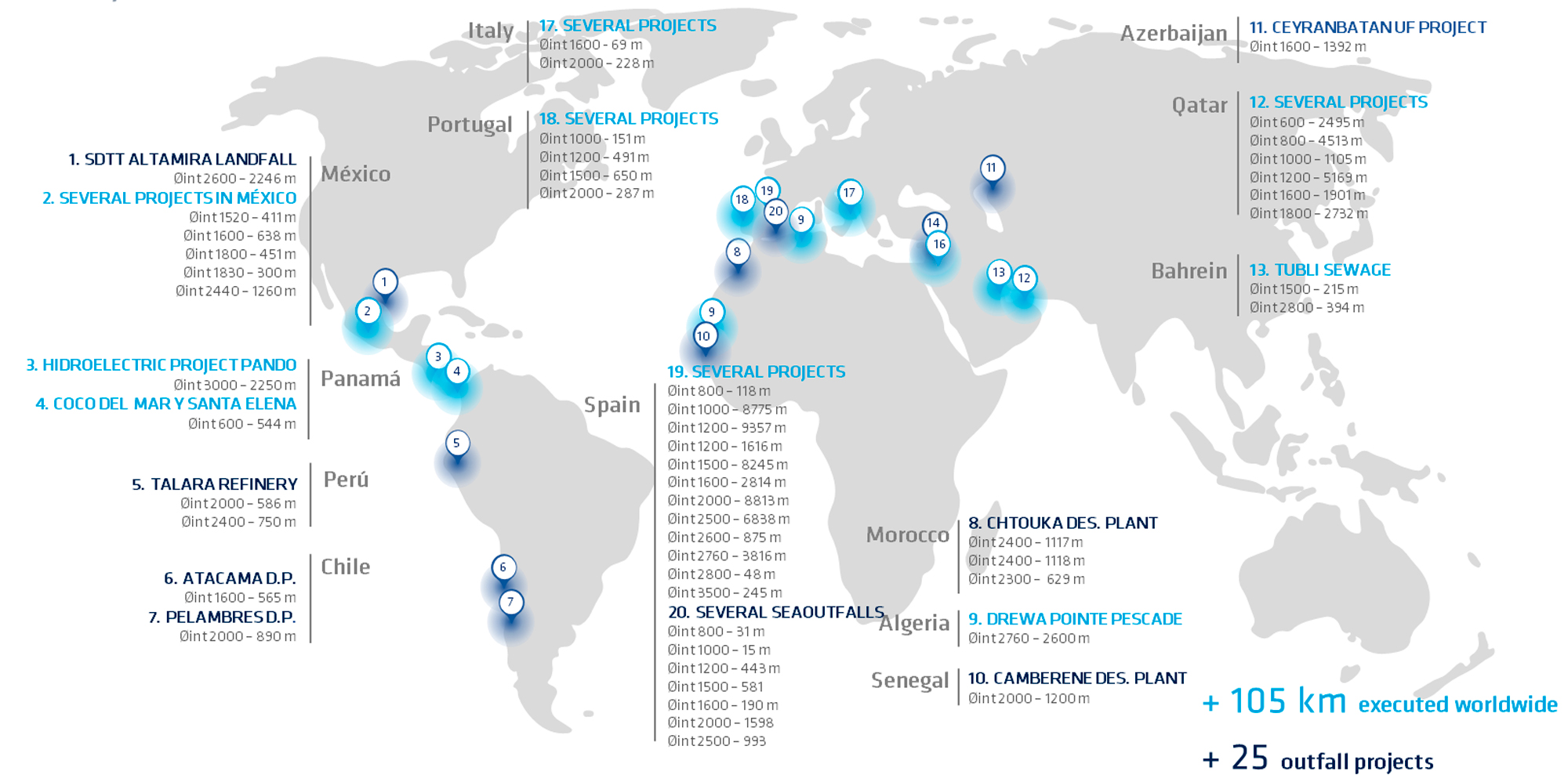
Eurohinca has built underground crossings for international projects in Europe, Latin America, and Asia. Since submarine emissaries to large-scale civil engineering projects, our solutions ensure durability, strength, and minimal environmental impact.

River and Waterway Crossings: Rapid Response

What Are River Crossings and Waterways?

River and watercourse crossings are projects to install a pipeline or construct a section crossing a riverbed, where the route and construction are determined by the surrounding environment and permitting requirements. Depending on the situation, these can be addressed using trenchless solutions such as horizontal directional drilling (HDD), microtunnel o pipe ramming.

When to use

They are used when it is necessary to cross a watercourse without digging a trench in the riverbed or to minimize the impact on the environment, and when the project is subject to access requirements, easements, and permits from the relevant agency. To compare with crossings under other infrastructure, see infrastructure crossings.

Minimum information for a first review

  • Approximate location and purpose of the junction (what you want to install or connect).

  • Sketch or plan with preliminary layout and start/end points.

  • Known environmental restrictions (access, occupancy, construction limitations).

  • Requirements of the authority/operator (if applicable) and any available documentation.

What you get after an initial review

  • Identification of main conditioning factors.

  • Short list of missing information (if any) and recommended next steps.

If you want to move forward with a query, you can do so from Contact.

Request for information

Do you need to design a river or waterway crossing for your project?

Our engineering team advises you throughout every phase, from design to commissioning.

News that may interest you

On our blog, we share News about underground infrastructure crossings and water projects, featuring real-world case studies and technological advancements that add value to complex projects.

Frequently asked questions about tunnels for river and watercourse crossings

Here we answer the most common questions about building tunnels under rivers and waterways. You can also visit our complete FAQ section For more information.

What are tunnels for river and watercourse crossings?

Tunnels for river and watercourse crossings are subway infrastructures that allow the safe passage of pipelines, cables and other services under bodies of water, avoiding the need for surface structures.

These tunnels minimize environmental impact, protect infrastructure from erosion and other risks associated with aquatic environments, and ensure the continuity and safety of essential services.

Eurohinca employs trenchless excavation techniques and closed shield tunnel boring machines, which ensure precise, safe construction with minimal environmental impact in river and watercourse crossings.

Trenchless excavation reduces disturbance to the environment, reduces costs and construction time, and ensures the stability and durability of tunnels built under bodies of water.

Subway tunnels for river and watercourse crossings can be used to install pipelines for drinking water, sewage systems, electrical and telecommunication cables, among other essential services.

Eurohinca uses advanced technologies, specialized equipment and has a team of expert engineers who supervise each stage of the project, ensuring that the tunnels meet the highest quality and safety standards.