
Lining with pipe jacking
Eurohinca (Europea de Hincas Teledirigidas, S.A.), a trenchless specialist since 1996 — 14 tunnel boring machines and >120 km of projects completed — develops solutions for pipe jacking (microtunneling, MTBM) for underpasses and underground utilities that require precision, pressure control y structural watertightness.
We run pipe jacking (microtunneling, MTBM) For underground crossings and utilities requiring precise alignment and pressure/leak testing.
We supplement this with HDD y
Direct Pipe.
See infrastructure crossings,
river crossings,
submarine emissaries,
recruitment y
references.
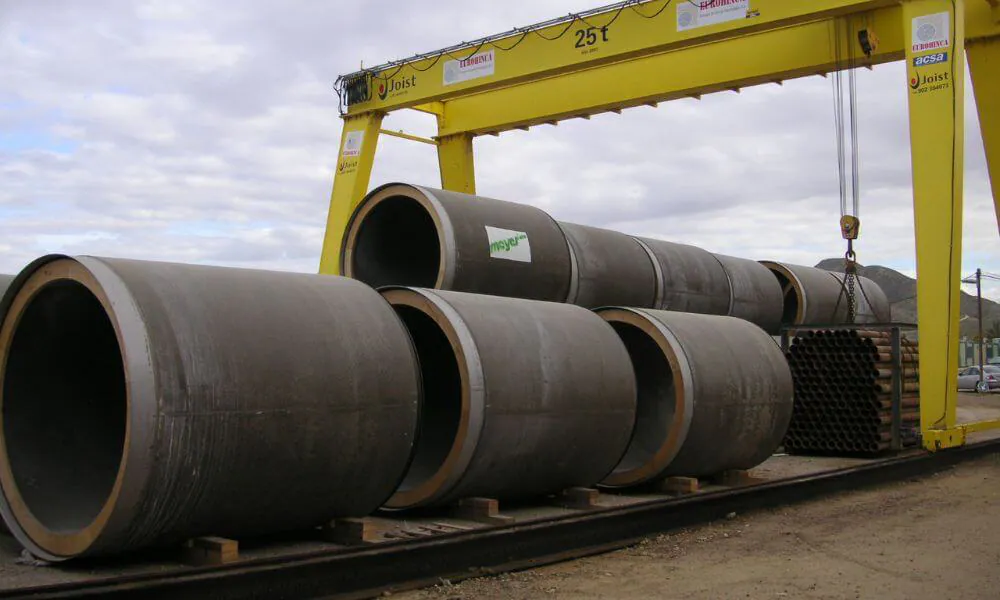
Pipe jacking process: installation and coating
The Reinforced concrete pipe driving It allows pipes to be installed without digging trenches, even in saturated soil, in areas with a high water table, or under roads and railways. As the excavation head advances from the attack shaft, the permanent pipeline is installed using hydraulic jacking, thereby ensuring alignment, slope, and structural capacity along the entire length of the section.
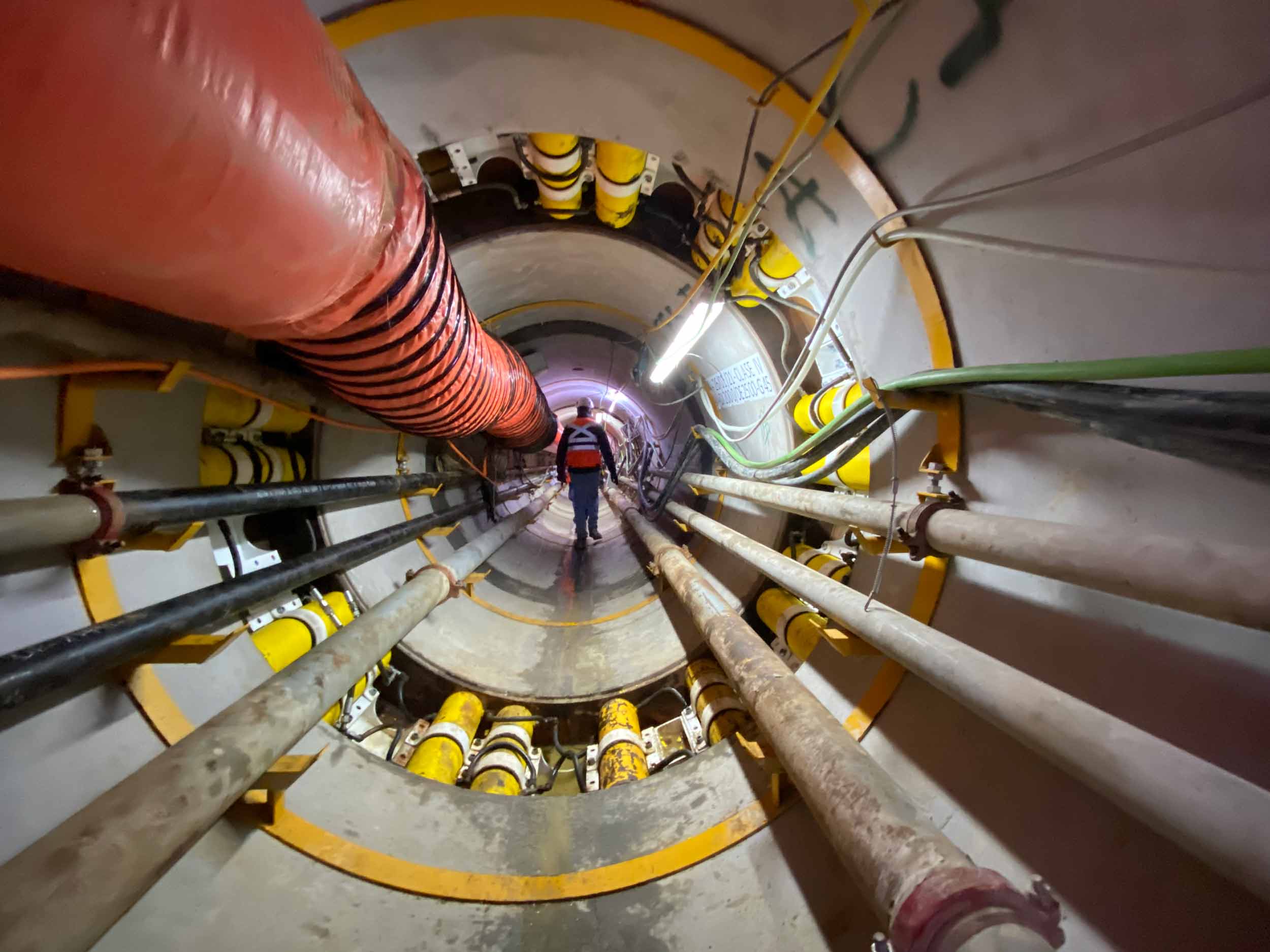
During excavation, the tunnel boring machine monitors pressure, muck removal, and chamber parameters, preventing settlement and maintaining the stability of the tunnel face. After reaching the reception shaft, the shield is removed, and the tunnel is inspected using CCTV, hydraulic tests, and geometric checks.
Check out our projects carried out using pipe jacking to see examples in different terrains and at different depths.
Pipe types and pipe driving techniques
Depending on the terrain, diameter, and intended use, different types of pipe are used:
Reinforced concrete, because of its structural strength and durability.
Vitrified stoneware, ideal for sewer systems.
Steel, on unstable ground or at special intersections.
During the process, you can apply back-of-wall mortar to stabilize the tube, and use auxiliary methods such as the guided thrust, closed shield or automatic guidance.
This type of installation is regulated by the ASTM D2321, international standards for the structural installation of pipes in underground construction projects using trenchless methods.
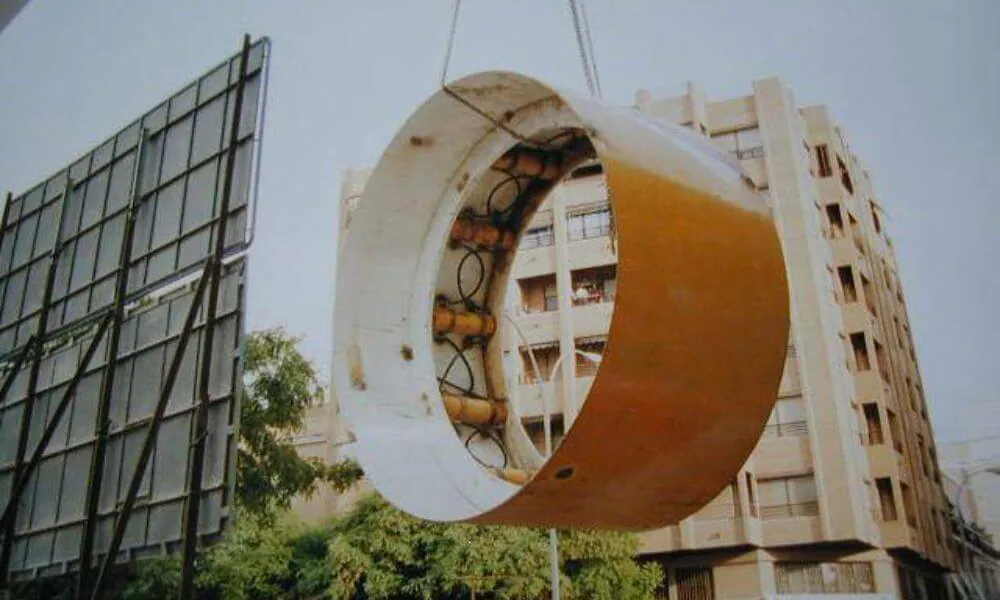
Pipe Driving Service Specifications
Pipe jacking is designed and executed based on a series of technical parameters and site conditions that determine its feasibility, the construction method, and the requirements necessary to ensure a safe and precise underground crossing. The following is a summary of the aspects that generally define this service:
• Main applications: Crossings WITHOUT trenches under roads, railways, urban areas, industrial sites, rivers, and watercourses, as well as connections to collection systems, supply networks, or sections associated with outfalls and intake structures.
• Diameter range (DN): Can be adapted to different diameters depending on the project and the type of pipe used. The selection is made during the engineering phase, taking into account stresses, thrust, and environmental conditions.
• Typical length of the sections: Straight or gently curved sections, with lengths that depend on the diameter, the coefficient of friction, and the possibility of using intermediate thrust stations when necessary.
• Suitable terrain conditions: Stabilized cohesive, mixed, and granular soils. Work can be performed in the presence of a water table or on saturated soil using pressurized heads (EPB or slurry support systems).
• Civil works prerequisites: Construction of a launch shaft and a reception shaft with dimensions and access points compatible with the tunnel boring machine, pipe logistics, slurry plant, and auxiliary equipment.
• Construction method and equipment: Construction using a remotely operated tunnel boring machine (MTBM) with hydraulic thrust, lubrication, and continuous control of advance, pressure, and muck removal, as well as laser or gyroscopic guidance depending on the alignment.
• Pipe materials used: Reinforced concrete is the standard solution, in addition to steel or other specific materials depending on the project’s hydraulic and structural requirements or regulatory standards.
• Quality control and safety: Monitoring of alignment, thrusts, cutting torque, chamber status, excavated volume, face stability, and working conditions in shafts. The tunneling is validated through CCTV, leak tests, and final geometric inspection.
What they think of us
Civil engineering firms, engineering companies, and public entities value Eurohinca’s technical precision, our ability to adapt, and our strict adherence to deadlines.
 Publicado en Google
 Carlos Vasconcello26 Enero 2026
 Publicado en Google
 Tidiane Ba17 Septiembre 2025BienPublicado en Google
 Marcelo Virgili27 Septiembre 2024Publicado en Google
 SERGIO ROJAS ROJAS16 Julio 2024Publicado en Google
 Dany Fernandez Vazquez14 Julio 2022Publicado en Google
 Victor Cabeza19 Marzo 2021Publicado en Google
 Eduardo18 Diciembre 2018Publicado en Google
 JuanK mesa17 Noviembre 2017

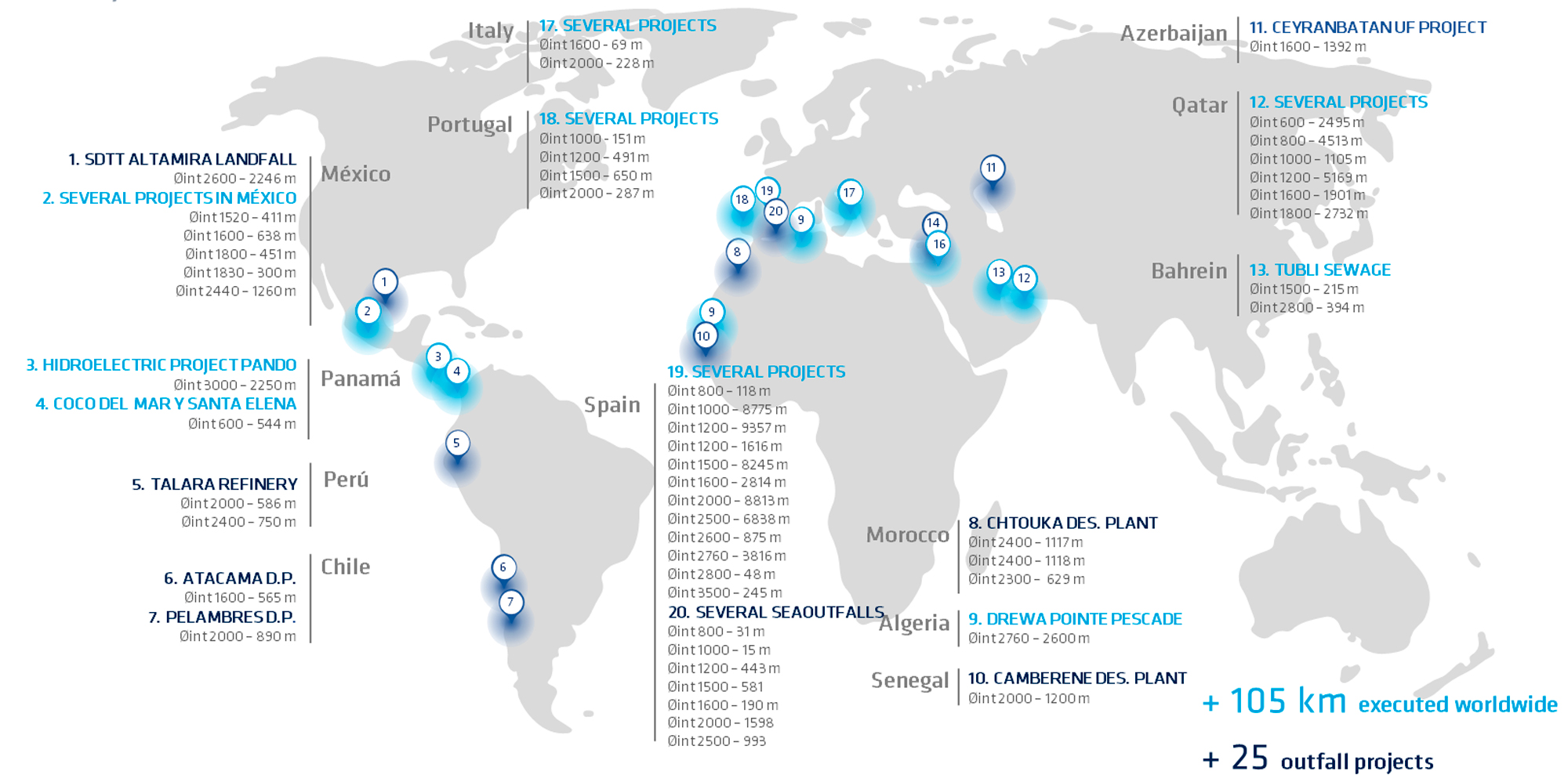
Projects around the world
More than 105 km of underground infrastructure carried out in urban areas, at road intersections, and at underpasses. Our experience includes projects in Spain, Mexico, Peru, Panama, and the Philippines.
Discover our works performed and cases adapted to different geotechnical conditions.
Pipe Installation: Rapid Response
What Is Pipe Driving?
The pipe ramming It is a trenchless method for installing pipes by pushing them from a launch point to a reception point, avoiding the need to dig a continuous trench at the surface. In terms of its application, it can be related to infrastructure crossings.
When Is Pipe Driving Used?
It is used when digging a trench is difficult or undesirable (due to traffic, easements, the presence of utilities, or environmental restrictions) and an underground section needs to be constructed. Depending on the situation, it can be compared to alternatives such as microtunnel.
Key data
Approximate location and purpose of the section (what is to be installed or connected).
Sketch or plan with preliminary layout and start/end points.
Known restrictions: access, occupancy, opening hours and existing services.
Recommended information
Information on available land (if any) and any nearby references.
Requirements of the owner/operator (if applicable) and environmental conditions.
If the crossing is under the riverbed, it can provide context. river and watercourse crossings.
Request for information
Are you looking for a technical solution for a trenchless underground crossing?
Fill out the form and we'll send you application details, sample plans, and comparable real-world examples. We'll respond within 48 hours.
Success Stories and Pipe-Driving Technologies
Explore content on planning, jacking techniques, and recommendations for trenchless construction.
Read more articles
From pipe jacking to tunnel boring machine: Key tools in project execution
In subway construction, the evolution of techniques and machinery is essential to carry out projects with quality, safety

What is driving in civil works?
Pile driving is a non-invasive construction method that allows the installation of subway pipelines and conduits by controlled pressure.

What is a pipe jacking?
Pipe jacking, also known as pipe jacking, is a pipe installation technique that is used to
Frequently asked questions about pipe ramming lining
Pipe jacking is a trenchless technique that allows pipes to be installed with millimeter precision without affecting the surface. Through hydraulic thrust and alignment control, it provides safe and durable solutions for sewer, drainage, and industrial utility networks.
Do you have any other questions? Check out our frequent questions.
What is pipe ramming and how is it performed?
The pipe ramming is a process in which prefabricated cylindrical pipes are installed in a subway tunnel. It is carried out by pushing the pipes from an attack shaft, using thrust cylinders that transfer the stress to the tunnel boring machine located at the face. During installation, bentonite or polymers can be injected to reduce friction and facilitate advancement.
What are the types of pipes used in ramming?
In the pipe rammingDepending on the project and soil conditions, various types of pipes are used. The most common include the reinforced concrete pipeThe most common types of pipes are the steel pipe, the polycrete or polyester resin pipe, and the ceramic or stoneware pipe. Each type of pipe is selected according to its characteristics and the required resistance.
What role do intermediate stations play in pipe ramming?
The intermediate stations in the pipe ramming are installed in long lengths to distribute the thrust stresses over several pipe segments. These stations help maintain process stability and reduce the risk of pipe deformation or failure, especially in long projects.
How is the tightness of the pipes ensured during installation?
Each drive pipe is fitted with a gasket on the nozzle to ensure a tight seal. watertightness. In addition, a "dolly" is incorporated into the pipe tail to absorb irregularities and facilitate a secure joint between the pipes, preventing leaks and ensuring efficient integration with the concrete.
What is the microtunneling or closed shield technique and how is it applied?
The microtunneling or closed shield technique is a method of subway excavation that uses a closed shield tunnel boring machine to perform excavation and lining simultaneously. This technique is ideal for difficult conditions and is used to install pipelines in tunnels with high precision and control.
What safety measures are taken during the pipe driving process?
During the pipe rammingIn addition, several safety measures are implemented, such as constant monitoring of ground conditions and equipment, regular maintenance of machinery, and training of personnel. Support and stabilization systems are also used to prevent problems during installation and ensure a safe working environment.
 Español
  English
  Français