
Horizontal directional drilling

Advantages of horizontal directional drilling
The horizontal directional drilling (HDD) is an extremely versatile trenchless technology, ideal for subway utility crossings in urban, industrial and natural environments. This method minimizes surface impact and eliminates the need for open trenches.
Its application is key in projects such as crossings of marine protected areas o submarine emissaries, where high precision and environmental friendliness are required.
This technique includes pilot drilling, flaring and casing phases by means of systems such as pull back o pipe ramming, adapting the diameter to the type of conduction.
How horizontal directional drilling is performed
The HDD process begins with a geotechnical and topographical study of the layout, followed by pilot drilling from a entry platform. The drill head is guided by probes to ensure the desired trajectory.
Subsequently, the tunnel is enlarged with tools from back-reaming and the final pipe is installed by hydraulic pull or push.
You can consult best practices and international standards on HDD in the International Institute of Directional Drilling (IADD) Handbook.

Horizontal directional drilling (HDD) service specifications
Horizontal directional drilling is a trenchless method for the installation of pipes and pipelines by means of guided pilot drilling, progressive reaming and final pulling of the product. Its design and execution are defined by the following parameters and technical conditions:
• Main applications: Subway crossings under roads, rivers, railway lines, protected natural areas or areas with strong excavation restrictions. It is used for supply networks, pressurized sewage, electrical conduits, fiber optics, gas and industrial systems.
• Range of installable diameters: The final pipe can have different diameters depending on the project and the type of material (HDPE, steel or others). The reaming diameter and tooling configuration are adjusted to the product pipe and ground conditions.
• Typical drilling lengths: Lengths of tens to several hundred meters, depending on depth, bend radius, allowable pipe stresses and the limits of the HDD equipment used.
• Radius of curvature and layout: Ability to execute curved layouts in plan and elevation, within the minimum radii allowed by the directional tools and the projected piping, respecting tensile and thrust stresses.
• Compatible land conditions: Cohesive, sandy, silty or mixed soils. The presence of gravels or hard transitions may require specific tools and drilling fluid adjustments. Water table control is part of the process using stabilizing muds.
• Construction method: Pilot drilling guided by probe and locator, followed by progressive reaming phases until the diameter required for the product pipe pull is reached. The final installation is carried out by controlled traction, monitoring tension and speed.
• Civil works prerequisites: Construction of accesses and entry and exit platforms, HDD equipment staging areas, sludge plant and logistic spaces for pipe and rod handling.
• Drilling fluids: Use of bentonite muds or polymers to stabilize the pilot hole, reduce friction, evacuate debris and ensure the integrity of the layout during drilling and reaming.
• Quality control and safety: Monitoring of trajectory, drilling parameters, fluid pressure, drawdown voltage and return volume. Crossing alignment, final condition of installed pipe and compliance with HSE protocols in drilling and pulling zones are verified.
What they think of us
Technical professionals and site managers highlight the precision of our directional drilling and the quality of the final execution, even in adverse geological conditions.
 Publicado en Google
 Carlos Vasconcello26 Enero 2026
 Publicado en Google
 Tidiane Ba17 Septiembre 2025BienPublicado en Google
 Marcelo Virgili27 Septiembre 2024Publicado en Google
 SERGIO ROJAS ROJAS16 Julio 2024Publicado en Google
 Dany Fernandez Vazquez14 Julio 2022Publicado en Google
 Victor Cabeza19 Marzo 2021Publicado en Google
 Eduardo18 Diciembre 2018Publicado en Google
 JuanK mesa17 Noviembre 2017

Projects around the world
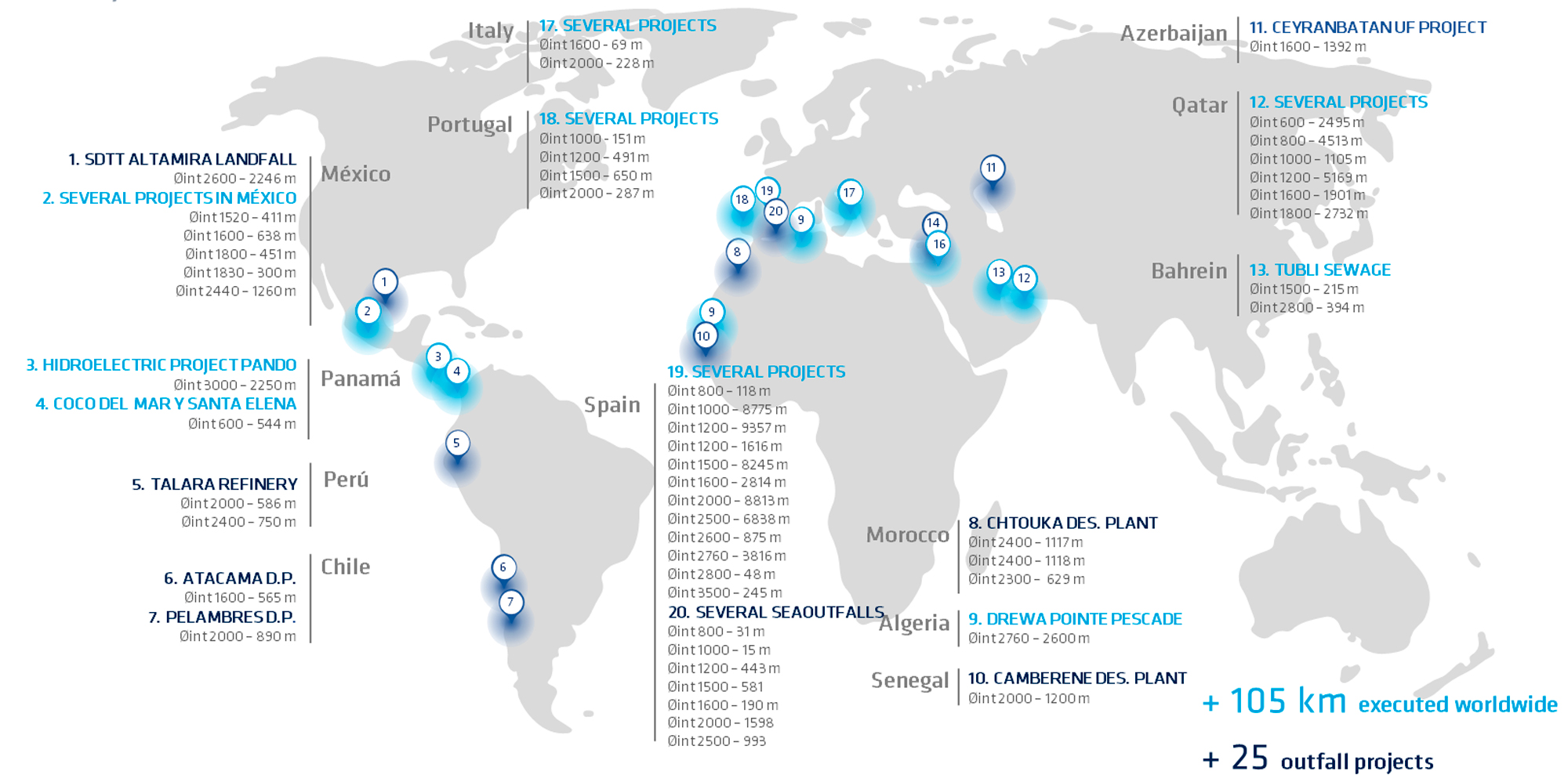
Our experience in reinforced concrete pipe ramming with closed shield TBMs spans three continents, with more than 25 outfall projects and crossings in demanding conditions. From rivers and roads to urban areas and seabeds.
Consult our works executed to see real cases.
Horizontal directional drilling: fast response
What is horizontal directional drilling (HDD)?
The horizontal directional drilling (HDD) is a trenchless method of installing pipelines by means of a guided borehole, avoiding continuous trenching on the surface. It is commonly used in crosses and steps under existing elements. For general context, it can be related to infrastructure crossings.
When to use the HDD
It is used when trenching is difficult or undesirable (due to traffic, easements, environmental impacts or presence of utilities) and the project requires the execution of a crossing or section with a subway route. Depending on the case, it can be compared with other trenchless solutions such as microtunnel o Direct Pipe.
Key data
Approximate location and purpose of the section (what is to be installed or connected).
Sketch or plan with preliminary layout and start/end points.
Known restrictions: access, occupancy, opening hours and existing services.
Recommended information
Information on available land (if any) and any nearby references.
Requirements of the owner/operator (if applicable) and environmental conditions.
If the crossing is under the riverbed, it can provide context. river and watercourse crossings.
Request for information
Do you have a project that requires horizontal directional drilling?
Tell us your requirements and we will help you define the best trenchless solution.
Advantages, applications and differences of horizontal directional drilling
Explore articles on HDD, its benefits over conventional methods and examples of execution under special conditions.
Read more technical articles

How does horizontal directional drilling work in tunneling?
Horizontal directional drilling (HDD) is a key technology in the construction of tunnels without the need for open excavations. Its

Advantages of horizontal directional drilling at infrastructure crossings
Horizontal directional drilling (HDD) has become an essential technique for subway crossings in infrastructure projects.
What is horizontal directional drilling?
Horizontal directional drilling, also known as HDD (Horizontal Directional Drilling), is a revolutionary technique that has transformed installation
Frequently asked questions about horizontal directional drilling
Horizontal directional drilling (HDD) is essential for the installation of pipelines, conduits and services in complex terrain without disturbing the surface.
Due to its precision, it is ideal for sensitive areas such as marine catchment systems o river and watercourse crossings.
More questions answered in our Technical FAQ
What is horizontal directional drilling?
The horizontal directional drilling is a technique trenchless to install pipes and pipelines accurately and efficiently. It consists of drilling the ground horizontally using a specialized machine, allowing the installation of pipelines without the need to dig extensive trenches.
What are the main advantages of using horizontal directional drilling?
The main advantages of the horizontal directional drilling include less surface disruption, reduced environmental impact, and the ability to install pipelines in areas with space restrictions or obstacles such as rivers and roads. It is also ideal for projects where high routing accuracy is required.
How is the horizontal directional drilling process performed?
The process consists of three phases: first, a pilot hole is drilled with a small-diameter drill bit from a target trench. Then, the pilot bore is enlarged with a reaming head. Finally, the pipe is installed using a pull back, completing the installation without the need for extensive excavation.
What types of projects are suitable for horizontal directional drilling?
The horizontal directional drilling is suitable for a variety of projects, such as the installation of utility pipelines, trenchless subway wells, y vertical wells. It is also used to pass pipes under rivers, roads, and buildings without disrupting the surface.
What type of machine is used for horizontal directional drilling?
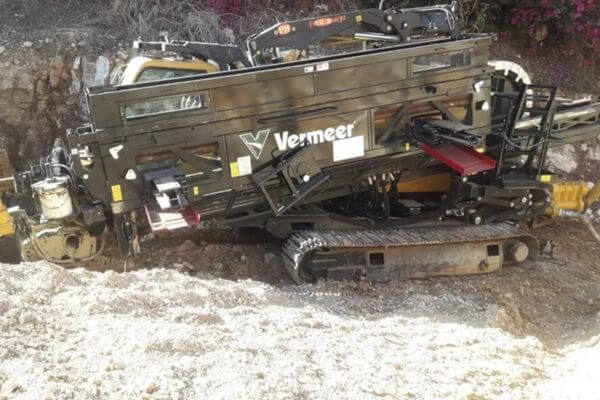
It uses a horizontal directional drilling machine equipped with specific tools for each phase of the process: pilot drilling, guide drilling extension, and back pulling for pipe installation. These machines are designed to offer high precision and control throughout the process.
What are the considerations for horizontal directional drilling in difficult terrain?
In difficult terrain, such as those with hard rock or unstable soils, it is important to adjust the machine configuration and drilling techniques to handle the conditions. Special tools and adapted drilling techniques can be used to ensure project success and minimize problems during installation.
 Español
  English
  Français