Urban supply systems

Eurohinca (Europea de Hincas Teledirigidas, S.A.), Trenchless specialist since 1996 - 14 TBMs and >120 km executed.

We run urban supply systems (pipeline extensions and network upgrades) with microtunneling (MTBM), HDD y Direct Pipe, integrated with civil work y wells — Minimal impact on traffic and services, and precise routing. See infrastructure crossings y references.

urban supply systems

Construction of urban supply systems

At Eurohinca, we develop projects in urban water supply using advanced trenchless excavation technologies. These solutions enable the safe installation of underground infrastructure, reducing the impact on the surface and ensuring an efficient and sustainable water supply.
Our experience includes the construction of tunnels for power lines and cables, as well as their integration with other systems such as the urban sewer system, drainage works y infrastructure crossings.

Tunnels for pipelines and power cables

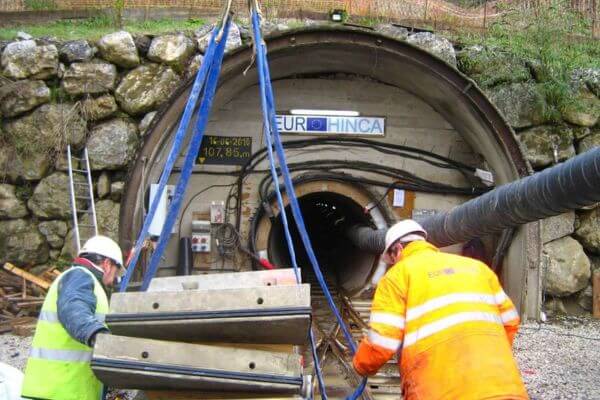
Our urban water supply projects include underground tunnels for water pipes and electrical lines, executed via closed shield tunnel boring machines, pipe ramming y horizontal directional drilling.
These techniques ensure high durability, minimal disruption to the surface, and the ability to adapt to densely populated urban areas.

The UN – UN-Water It emphasizes that efficient urban water supply systems are essential for sustainable development and public health in modern cities.

construction of urban supply systems

Service Specifications for Urban Water Supply Systems

Urban water supply systems require pipelines that are safe, stable, and have minimal impact on the surface, especially in established urban areas. Trenchless technologies allow for the installation of pressure pipes and deep pipelines with controlled alignment and hydraulic continuity. This service is defined by the following technical parameters:

Main applications: Installation of drinking water pipelines, main distribution lines, reinforcement branches, connections between reservoirs, underpasses beneath avenues, crossings beneath infrastructure, and renovation of water supply networks without interrupting service.

Construction methods used: Remote-controlled microtunneling, pipe jacking, Direct Pipe®, and horizontal directional drilling (HDD), selected based on geotechnical conditions, operating pressure, alignment, and urban environmental constraints.

Pipe diameters and types: Pipes made of steel, ductile iron, concrete, or specialized materials for pressurized systems. The choice depends on the hydraulic capacity, external loads, and the municipal operator’s standards.

Soil conditions and water table: Suitable for cohesive, mixed, sandy, or saturated soils. In areas with groundwater or a risk of soil decompression, pressurized shields (EPB or Slurry) are used to ensure stability at the cutting face.

Lengths and geometry of the intersections: Short and medium-length sections under streets or industrial areas; longer crossings under linear infrastructure; the possibility of gently curving alignments when the method allows (HDD or specific microtunneling solutions).

Civil works prerequisites: Access pits, work platforms, access points, storage areas for piping and equipment, and space for a sludge treatment plant and auxiliary machinery.

Compatibility with service continuity: Trenchless technologies allow new pipelines to be installed without interrupting the existing water supply, thereby reducing water outages, traffic disruptions, and inconvenience to residents.

Quality Control and Hydraulic Parameters: Verification of alignment, front pressure, thrusts, excavated volume, pipe integrity, and leak tests. For pressurized pipelines, specific tests are performed in accordance with the operator’s regulations.

Safety and the Urban Environment: Access management, vibration control, signage, ventilation in shafts, minimization of noise impact, and compliance with HSE protocols in urban environments and confined spaces.

What they think of us

International Experience

Projects around the world

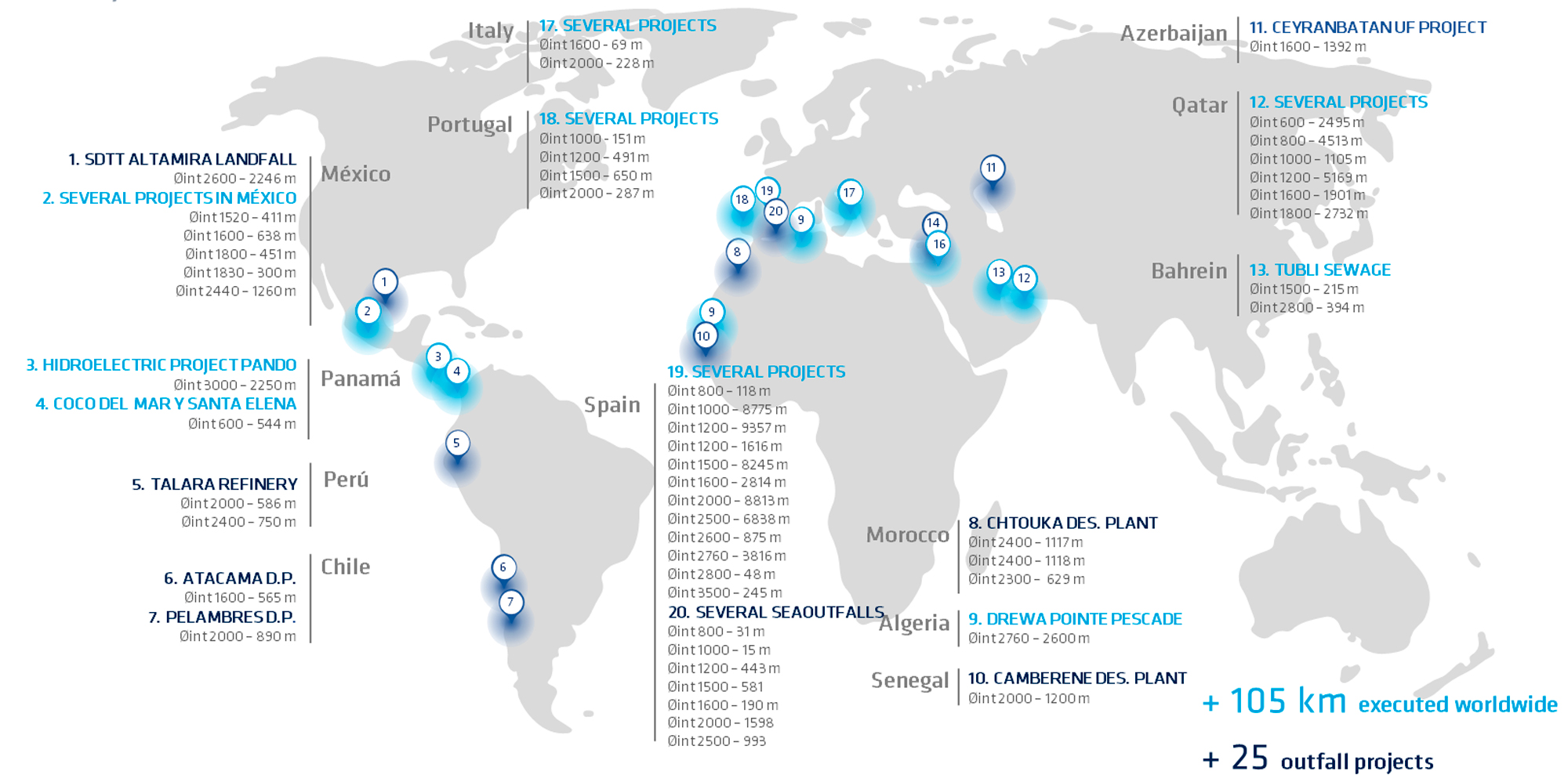
We have implemented urban water supply systems in various countries, integrating these solutions with gas pipelines y seawater intake systems for desalination.
Learn more in our works executed.

Urban Water Supply Systems: Rapid Response

What Is an Urban Water Supply System?

A urban supply system is the set of infrastructure and networks intended to collect, convey, store, and distribute water to supply a community. Depending on the environment, some of these measures may require crossings or sections with restrictions.

When to use

It is used in projects involving new infrastructure, expansion, or renovation water networks in urban settings, especially when there are constraints such as traffic, easements, or existing utilities. If the project includes crossings under infrastructure, it may involve infrastructure crossings.

Key data

  • Approximate location and purpose (new pipeline, renovation, connection, reinforcement).

  • Sketch or plan with a preliminary layout and connection points.

  • Known environmental restrictions (access, occupancy, hours, interference).

Recommended information

  • Available documentation on the existing network (as-built drawings, historical records).

  • Operator/administrative requirements (if applicable).

  • If there are sections that must be constructed WITHOUT a trench, please provide some context pipe ramming y horizontal directional drilling (HDD).

Request for information

Do you need to implement an urban supply system in your city?

Contact us, and we'll help you design the most efficient and sustainable solution.

News that may interest you

Consult our news about urban water supply systems, where we share recent projects, technical innovations, and solutions implemented in various countries.

Frequently asked questions about urban supply systems

We answer the most frequently asked questions about our urban supply systems and their integration with other critical infrastructure. For more details, visit our frequently asked questions section.

What technologies does Eurohinca use in the construction of urban supply systems?

Eurohinca uses advanced trenchless excavation technologies and closed shield tunnel boring machines to construct urban supply systems efficiently and with minimal surface disruption.

Trenchless excavation reduces environmental impact and surface disruptions, decreases costs and construction time, and allows for accurate and safe installation of pipes and cables.

Eurohinca guarantees the quality of its projects through the use of state-of-the-art equipment, a team of engineering and construction experts, and advanced techniques that ensure precision and durability.

The subway tunnels built by Eurohinca are ideal for the installation of water pipes, power cables and other essential infrastructure, improving the efficiency and sustainability of urban systems.

The use of subway tunnels allows for safer and more secure installation of pipes and cables, reduces the risk of damage and facilitates the maintenance and expansion of urban infrastructures.

With over 20 years of experience and more than 240 completed projects internationally, Eurohinca is a leader in subway tunnel construction, offering innovative and safe solutions for a variety of urban applications.

Solve your doubts in our section of frequent questions.