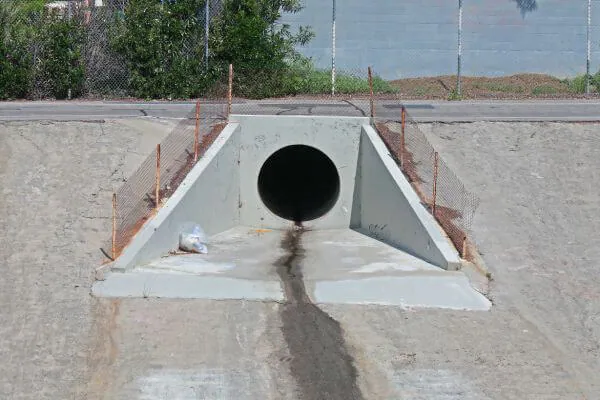
What type of tunnels are most suitable for storm drainage works?
Stormwater drainage works require efficient and sustainable solutions for stormwater management and prevention
Eurohinca (Europea de Hincas Teledirigidas, S.A.), Trenchless specialist since 1996 - 14 TBMs and >120 km executed.
We run urban sewage systems (ground-level collectors and outfalls) with microtunneling (MTBM), HDD y Direct Pipe, integrated with civil work — Minimal impact on traffic and services, and precise routing. See infrastructure crossings y references.

At Eurohinca, we develop urban sewage systems that enable efficient wastewater management in modern cities. We are committed to trenchless excavation solutions that reduce the impact on the surface and facilitate integration with other infrastructure.
This experience allows us to carry out projects that combine the urban water supply, the stormwater drainage and water treatment, always ensuring safety and sustainability.
We use technologies from pipe ramming, microtunnels y closed shield tunnel boring machines to build urban sewer systems without disrupting traffic or damaging existing infrastructure.
Thanks to these techniques, it is possible to install systems in complex soils, ensuring durability and minimizing maintenance costs.
The WHO – World Health Organization It emphasizes that efficient sewer systems are essential for public health and the sustainability of cities.

Urban sewer systems require precise construction solutions with minimal surface impact, especially in established areas or those with a high density of utilities. Trenchless technologies allow for the safe installation of collectors, service connections, and deep pipelines with precise geometric control. This service is defined by the following technical parameters:
• Main applications: Installation of main and secondary collectors, gravity-fed sewer lines, connections between manholes, crossings under urban infrastructure, and renovation of existing networks without the need for extensive trenching.
• Construction methods used: Remote-controlled microtunneling, pipe jacking, and, in some cases, accessible tunnels or service galleries for large diameters. The choice depends on depth, geotechnical conditions, alignment, and urban restrictions.
• Pipe diameters and types: Reinforced concrete pipes are commonly used for main sewer lines, along with steel, vitrified clay, or other materials, depending on the municipality’s hydraulic and structural requirements and regulations.
• Soil conditions and water table: Suitable for cohesive, mixed, and stabilized granular soils. In areas with groundwater, pressurized shields (EPB or slurry) are used to ensure stability and prevent surface movement.
• Slope and Alignment Control: Urban sewer lines require specific gradients to ensure gravity flow. Laser or gyroscopic guidance allows the elevation and axis of the sewer line to be maintained within strict tolerances.
• Track lengths and geometries: Short and medium-length underpasses beneath streets, avenues, or congested service areas. When required by the design, sections with gentle curves in plan or elevation may be constructed.
• Civil works requirements: Manholes and receiving chambers adapted to the diameter and depth of the sewer, access points for machinery, a sludge treatment plant, and space for pipe handling—all while minimizing disruption to traffic and urban life.
• Compatibility with existing networks: Trenchless technologies help avoid interference with drinking water, gas, electricity, telecommunications, and underground infrastructure, thereby reducing operational risks and downtime.
• Quality control and safety: Monitoring of thrust, torque, debris removal, face pressure, and alignment. Final verification through CCTV inspection, leak tests, and as-built documentation of the completed sewer.
Publicado en Google Carlos Vasconcello26 Enero 2026 Publicado en Google Tidiane Ba17 Septiembre 2025 BienPublicado en Google Marcelo Virgili27 Septiembre 2024 Publicado en Google SERGIO ROJAS ROJAS16 Julio 2024 Publicado en Google Dany Fernandez Vazquez14 Julio 2022 Publicado en Google Victor Cabeza19 Marzo 2021 Publicado en Google Eduardo18 Diciembre 2018 Publicado en Google JuanK mesa17 Noviembre 2017
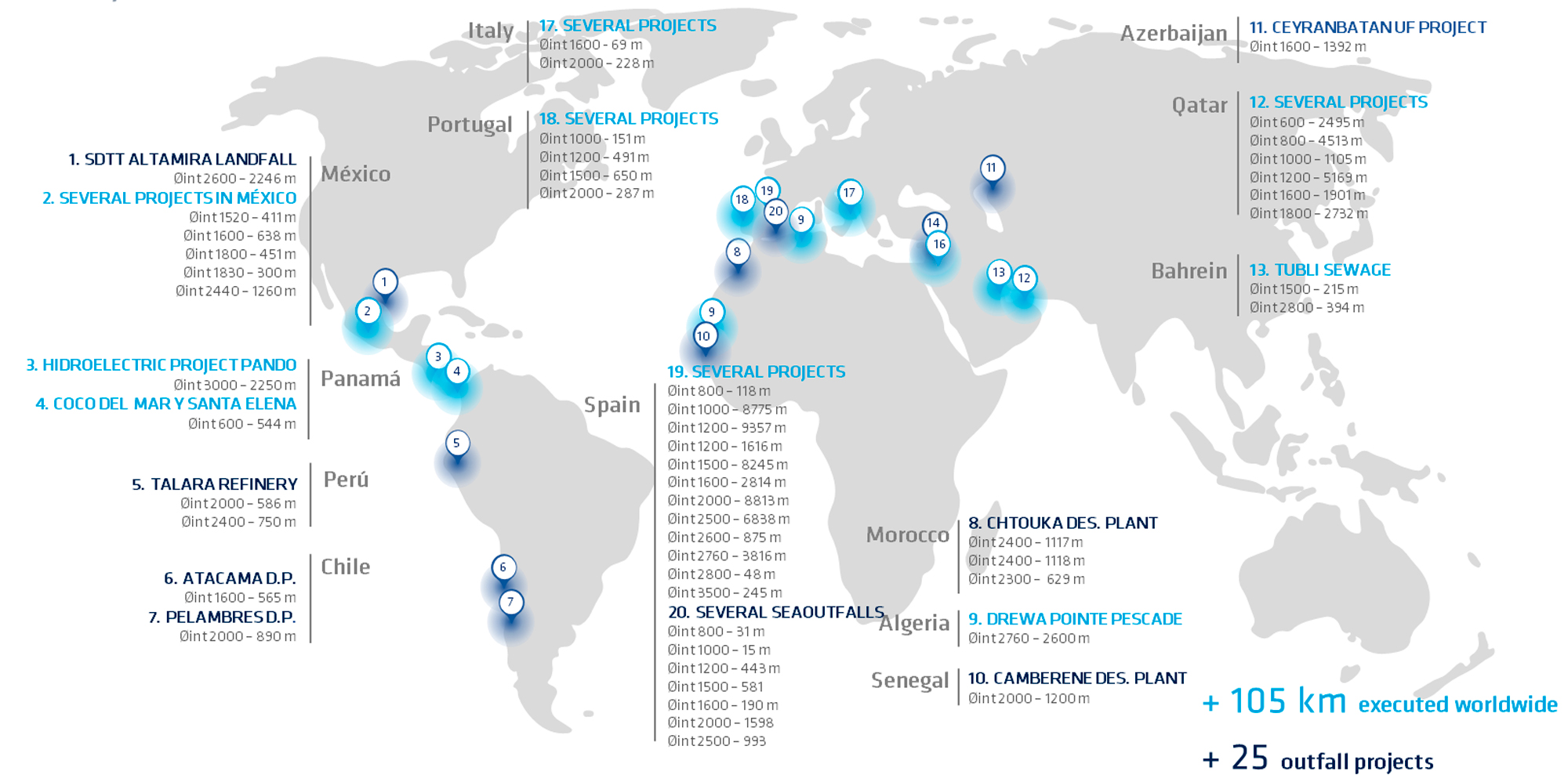
We have carried out urban sewer projects in Europe and Latin America, combining these infrastructure projects with infrastructure crossings y water collection systems for multiple uses.
Learn more in our works executed.
The urban sewage systems are the set of infrastructures and networks intended to collect and transport wastewater and/or stormwater within a city, connecting service connections, collectors, and discharge or treatment points.
They are used in projects involving new network, expansion, renovation, or upgrade sanitation in urban environments, especially when there are constraints such as traffic, easements, existing utilities, or the need to maintain operations in the area. If the project includes underpasses beneath infrastructure, it may involve infrastructure crossings.
Approximate location and purpose (new pipeline, renovation, connection, capacity increase).
Sketch or plan with a preliminary layout and connection points.
Known environmental restrictions (access, occupancy, hours, interference).
Available documentation on the existing network (as-built drawings, historical records, problem areas).
Operator/administrative requirements (if applicable).
If there are sections that must be constructed WITHOUT a trench, please provide some context microtunnel y pipe ramming.
Contact us, and we'll help you find the best solution tailored to your project.
Explore our News about urban sewer systems, where we showcase examples of actual projects, technical innovations, and the benefits of trenchless construction.

Stormwater drainage works require efficient and sustainable solutions for stormwater management and prevention

In the field of subway engineering, segmental tunnels stand out as an essential solution for large-scale projects.

Horizontal directional drilling (HDD) has become an essential technique for subway crossings in infrastructure projects.
Get answers to your questions about urban sewer projects, the benefits of trenchless excavation, and Eurohinca’s role in their implementation. For more details, visit our frequently asked questions section.
Trenchless excavation is a subway construction technique that allows the installation and maintenance of infrastructure without the need for major surface excavations. It is beneficial because it minimizes ground disruption, reduces costs and construction time, and reduces environmental impact.
Eurohinca specializes in the construction of subway tunnels for urban sewer systems, using advanced trenchless excavation technologies to ensure efficiency and precision in every project.
Eurohinca uses closed shield tunnel boring machines and state-of-the-art equipment, along with a team of engineering and construction experts, to ensure quality, accuracy and safety in every trenchless tunneling project.
The tunnels built by Eurohinca are used in urban sewage systems, drinking water pipelines, telecommunications networks and other subway infrastructures that require efficient installation and minimal disruption to the surface.
Subway tunnels enable efficient wastewater management, improve urban infrastructure, and reduce the risk of flooding and environmental damage. The trenchless excavation technique ensures precise installation and reduces impacts on the urban surface.
With over 20 years of experience and more than 240 completed projects internationally, Eurohinca is a leader in trenchless tunnel construction, offering innovative and safe solutions for a variety of urban and subway applications.
Solve your doubts in our section of frequent questions.