What type of tunnels are most suitable for storm drainage works?
Stormwater drainage works require efficient and sustainable solutions for stormwater management and prevention
Eurohinca (Europea de Hincas Teledirigidas, S.A.), Trenchless specialist since 1996 - 14 TBMs and >120 km executed.
We run gas pipeline tunnels with microtunneling (MTBM), segment tunnel, HDD y Direct Pipe — precise layout, minimal impact, and compliance with ISO 9001/14001/45001.
See infrastructure crossings y references.

At Eurohinca, we specialize in the construction of underground tunnels for gas pipelines, using trenchless excavation techniques that ensure safety, durability, and environmental responsibility. Our solutions are tailored to large-scale projects, such as infrastructure crossings, urban supply systems and works by civil engineering.
The construction of tunnels for gas pipelines requires the utmost precision and safety. At Eurohinca, we use methods such as the pipe ramming and the horizontal directional drilling to install pipelines under rivers, roads, and in complex urban environments.
In addition, we use advanced technology to minimize risks and ensure structural stability.
The International Gas Union (IGU) emphasizes the importance of implementing natural gas transportation systems that combine efficiency and sustainability—goals that are part of our commitment in every project.

Tunnels and underground conduits for gas pipelines require trenchless solutions that ensure safety, structural integrity, and regulatory compliance in urban and industrial environments and beneath sensitive infrastructure. The choice of construction method and detailed engineering are determined by the following technical parameters:
• Main applications: Gas pipeline crossings under roads, railroads, waterways, industrial zones, protected areas, and areas where open-cut excavation is not feasible. It is also used for pipeline branching, reinforcement, and the renewal of strategic networks.
• Construction methods used: Steel pipe jacking, remote-controlled microtunneling for pressure pipelines, Direct Pipe® for straight and long runs, and HDD for specific crossings when geotechnical conditions permit.
• Pipe type: Welded steel is the standard solution for natural gas pipelines due to their pressure requirements, integrity, and industry regulations. The coating and corrosion protection are tailored to the project and the operator.
• Ground conditions: Suitable for cohesive soils, mixed soils, stabilized sand, and areas with a high water table. On unstable or permeable ground, pressurized shields (EPB or Slurry) are used to ensure the stability of the cutting face.
• Typical lengths of the crossing: From short sections in urban areas to several hundred meters in underpasses beneath highways, riverbeds, or hard-to-reach areas, depending on the method and logistics.
• Depth and Coverage Requirements: Gas pipelines require minimum cover depths to protect the pipeline from external loads, vibrations, erosion, and hydraulic forces. The design complies with applicable regulations and the gas operator’s criteria.
• Civil works requirements: Launch and reception pits of sufficient size to accommodate steel pipe handling, welding, jacking equipment, a slurry plant, and ventilation and safety systems.
• Structural integrity and stress analysis: Monitoring of thrust, stresses, shear torque, chamber pressure, and pipe behavior during pushing or pulling. Direct Pipe® specifically monitors continuous thrust and the structural response of the steel.
• Quality Control and Regulations: Leak and integrity tests, final inspection using NDT, geometric verification of the route, as-built tests, and compliance with the gas operator’s requirements and regulations governing the transportation of pressurized gas.
• Operational safety: Risk management in confined spaces, atmosphere monitoring, signage, strict HSE protocols, and coordination with operators to prevent disruptions to ongoing service.
Publicado en Google Carlos Vasconcello26 Enero 2026 Publicado en Google Tidiane Ba17 Septiembre 2025 BienPublicado en Google Marcelo Virgili27 Septiembre 2024 Publicado en Google SERGIO ROJAS ROJAS16 Julio 2024 Publicado en Google Dany Fernandez Vazquez14 Julio 2022 Publicado en Google Victor Cabeza19 Marzo 2021 Publicado en Google Eduardo18 Diciembre 2018 Publicado en Google JuanK mesa17 Noviembre 2017
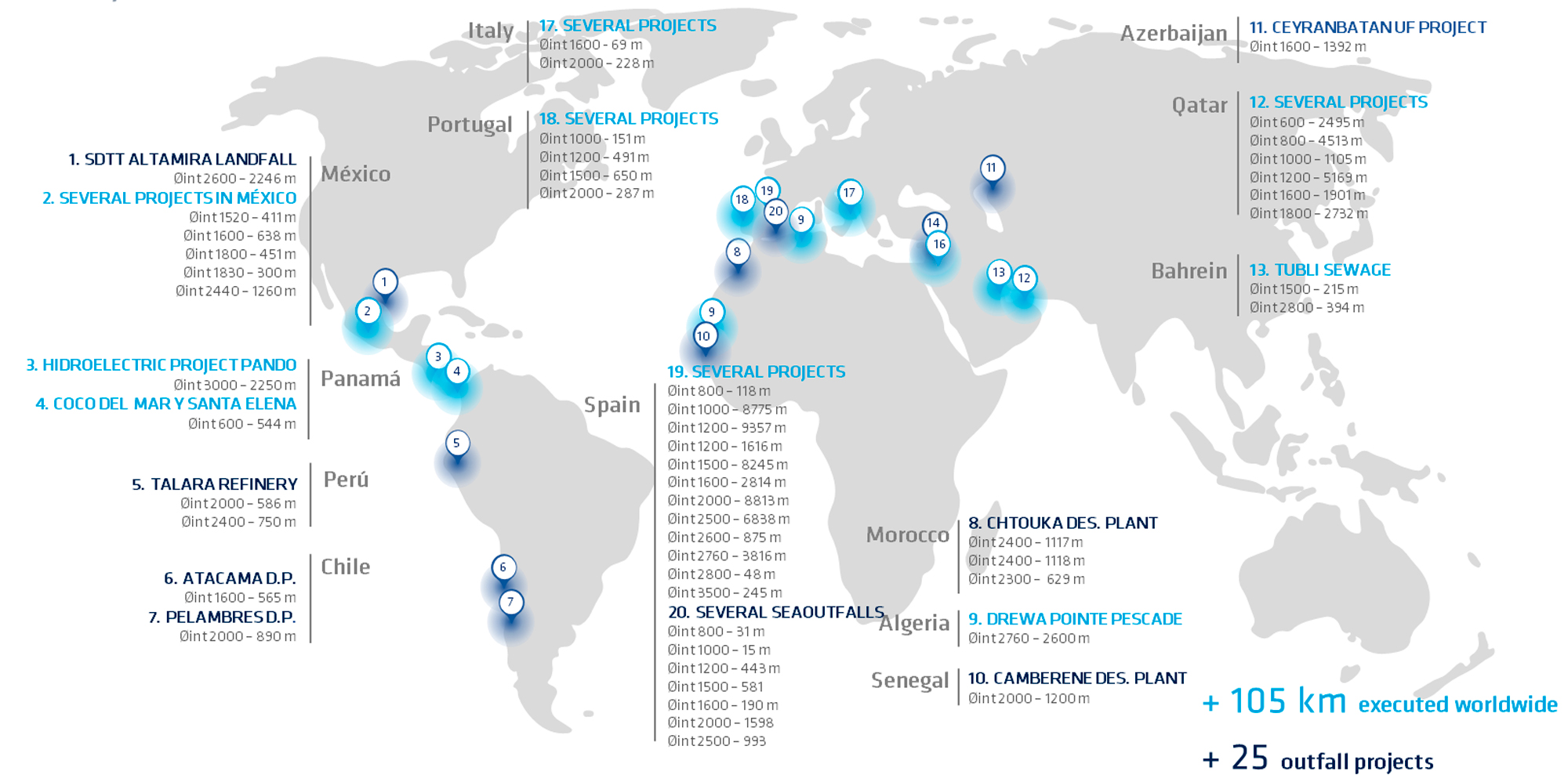
We have constructed tunnels for gas pipelines in international projects, including seawater catchments, river and watercourse crossings y submarine emissaries.
Learn more in our works executed.
The gas pipeline tunnels These are solutions for housing or protecting a gas line in an underground section, typically associated with crosses or work in restricted areas where digging a trench may not be feasible. For general context regarding this type of work, it may be helpful to infrastructure crossings.
They are used when the gas pipeline route must cross existing infrastructure or areas subject to easements, occupancy restrictions, or requirements set by the owner or operator. Depending on the situation, they may be associated with trenchless solutions such as microtunnel o pipe ramming.
Approximate location and purpose of the section (intersection, crosswalk, connection).
Sketch or plan with preliminary layout and start/end points.
Known environmental restrictions (access, occupancy, hours, interference).
Available documentation on the site (plans, background information, and constraints).
Requirements for the owner/operator (if applicable) and operational limitations.
If the crossing is under the riverbed, it can provide context. river and watercourse crossings and, if alternatives are evaluated, horizontal directional drilling (HDD).
Contact us, and our engineers will guide you through every step, from design to implementation.
Keep up to date with our News about gas pipeline projects and underground construction projects, where we share real-life experiences, innovations, and success stories.

Stormwater drainage works require efficient and sustainable solutions for stormwater management and prevention

In the field of subway engineering, segmental tunnels stand out as an essential solution for large-scale projects.

Horizontal directional drilling (HDD) has become an essential technique for subway crossings in infrastructure projects.
Here we answer the most common questions about the construction of gas pipeline tunnels. You can also visit the complete section on frequent questions to learn more technical details.
Subway tunnels protect pipelines from environmental and physical factors, reducing the risk of damage and improving the safety and efficiency of natural gas transportation.
Eurohinca employs trenchless excavation techniques and closed shield TBMs, allowing for precise installation and minimizing surface impact.
Trenchless excavation reduces ground disruption, decreases costs and construction time, and minimizes environmental impact, ensuring a more efficient and safer process.
Eurohinca has more than 20 years of experience in subway tunnel construction, offering innovative and safe solutions for a variety of applications, including gas pipelines.
Eurohinca uses advanced technologies and has a team of expert engineers who supervise each stage of the project, ensuring that the tunnels meet the highest quality and safety standards.
Gas pipeline tunnels built by Eurohinca are designed to be durable and require minimal maintenance, ensuring efficient and continuous operation of the gas transportation system.